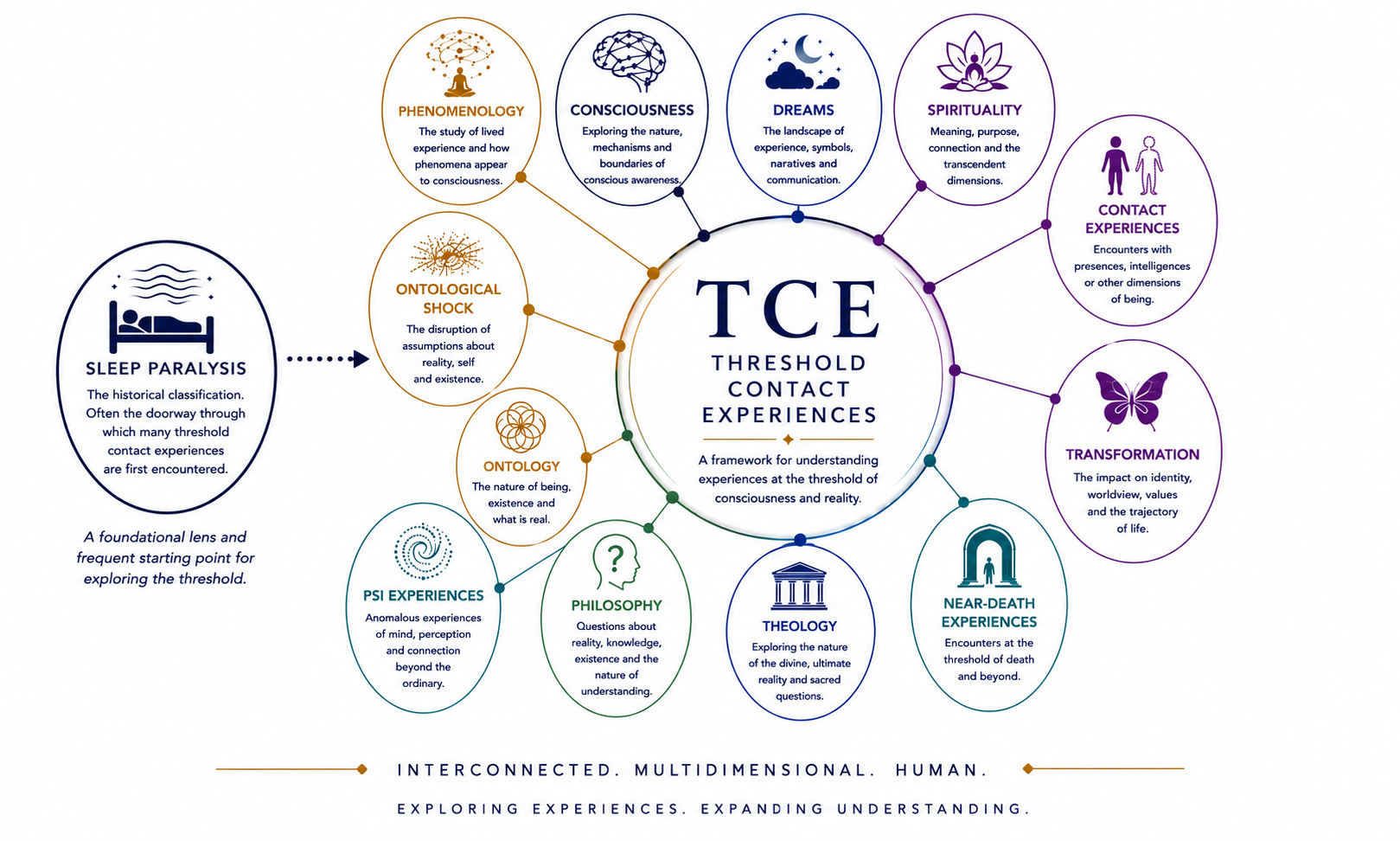
Beyond the Sleep–Wake Transition
What If We've Been Looking at Only Part of the Picture?


One of the most satisfying moments in research is recognising that a series of observations is pointing towards something larger. This has been the journey of the Threshold Contact Experience (TCE) framework.
Over recent months, I have explored the recurring phenomenological features that characterise these experiences. We have examined Presence, Interaction, Environment, Agency and Memory Carryover, demonstrating that people from different cultures, backgrounds and belief systems often describe similar patterns despite interpreting them in very different ways.
Taken together, these observations suggest that Threshold Contact Experiences are not simply collections of unusual sensations. They possess an internal structure. The experiences are organised rather than random, coherent, and they display a level of consistency that deserves careful attention.
Identifying these recurring features has been an important milestone. At the same time, however, they have raised a question that I have found increasingly difficult to ignore.
Why do these particular features occur together so consistently?
That question represents an important shift in perspective. Until now, my focus has been on describing what people experience. The next step is to ask whether these recurring patterns point towards a distinctive condition of consciousness within which they consistently unfold. To understand why this question matters, it is helpful to consider how sleep paralysis has traditionally been understood.
Within clinical sleep medicine, sleep paralysis is defined as a transient inability to move that occurs during the transition into or out of sleep while conscious awareness is maintained. This explanation, grounded in the persistence of REM sleep muscle atonia into wakefulness, provides a robust account of the temporary paralysis itself and remains an essential part of our understanding of the phenomenon.
However, describing when an experience occurs is not necessarily the same as understanding the condition of consciousness within which it unfolds.
The sleep–wake transition identifies the biological circumstances surrounding the experience. It explains why someone may awaken unable to move and provides an important physiological account of the paralysis itself. Yet the recurring phenomena described by experiencers often extend far beyond paralysis alone.
Across countless reports, individuals describe coherent environments, sustained interactions, autonomous presences, vivid sensory perception, purposeful communication, enduring autobiographical memories and, for many, profound personal transformation. Although interpretations vary, the underlying structure of these experiences frequently displays striking similarities.
These observations do not invalidate the physiological explanation. Rather, they suggest that physiology and phenomenology are addressing different, but complementary, questions. One asks what is happening in the brain and body. The other asks what kind of conscious experience consistently emerges within that condition.
As the Threshold Contact Experience framework has developed, this distinction has become increasingly important to me. The more accounts I have studied, the more I have found myself wondering whether describing these experiences simply as events occurring “during the sleep–wake transition” captures only part of what is taking place. It may be that the sleep–wake transition provides the biological circumstances in which these experiences occur and does not fully describe the condition of consciousness in which they unfold.
If that is the case, then the framework requires something more.
What it requires is a way of describing the condition itself without making assumptions about its ultimate cause.
This distinction matters because it allows us to separate two questions that are often merged together.
The first asks what is being encountered?
These are not the same question, and they do not need to be answered in the same order.
Whether the entities reported during Threshold Contact Experiences are psychological constructions, neurological phenomena, independent intelligences or something else entirely is open to debate. My aim is not to resolve that debate here. Instead, I believe there is value in first describing, as carefully as possible, the condition within which these experiences consistently unfold.
Seen from this perspective, the five Core Features begin to take on a new significance. Presence, Interaction, Environment, Agency and Memory Carryover are no longer simply recurring observations. Together, they describe the internal organisation of a distinctive experiential condition. Individually they tell us something about the experience; collectively they suggest that we are observing a coherent pattern that deserves to be recognised in its own right.
This does not prove that such a condition exists as a discrete state of consciousness, nor does it establish the ultimate nature of the experiences themselves. What it does suggest is that the recurring is sufficiently consistent to justify introducing a conceptual framework capable of describing it.
It is this reasoning that has led me to propose the concept of the Threshold State.
By the Threshold State, I do not simply mean the brief physiological transition between sleep and wakefulness, nor do I intend it as a replacement for the established physiological understanding of sleep paralysis. Instead, I use the term to describe the distinctive phenomenological condition of consciousness within which the recurring features of Threshold Contact Experience consistently emerge.
This distinction is, I believe, both simple and important.
The sleep–wake transition describes when these experiences occur.
The Threshold State provides a framework for exploring the condition of consciousness within which they unfold.
One describes the biological circumstances surrounding the experience.
The other seeks to describe the experiential condition itself. Far from competing with one another, these perspectives operate at different levels of analysis and have the potential to complement one another.
For me, this represents the next stage in the development of the Threshold Contact Experience framework. The earlier articles in this series established that recurring phenomenological patterns exist. The natural question that follows is whether those patterns point towards a recognisable condition of consciousness that deserves to be described in its own right.
That is the purpose of this concept.
Like the broader Threshold Contact Experience framework, it should be understood as a developing phenomenological construct rather than an established scientific fact. It is offered as a way of organising recurring observations, not as a final explanation for them.
For decades, discussion has centred largely on the mechanisms that produce temporary paralysis during the transition between sleep and wakefulness. Those mechanisms are important and continue to provide an essential foundation for research. Yet if the Threshold Contact Experiences have taught me anything, it is that understanding these experiences may require us to ask an additional question.
Not simply when do they occur?
For me, that question marks the beginning of the next stage of this research journey.
The sleep–wake transition tells us when these experiences occur. The Threshold State is a framework for exploring the condition of consciousness within which they unfold.
Support the Development of the TCE Framework
If this article resonated with you and you would like to support the continued development of the Threshold Contact Experience framework, there are several ways you can help.
• Subscribe to receive future essays as the framework continues to develop.
Free subscribers receive new essays delivered to their inbox and can follow the ongoing development of the framework.
Paid subscribers receive:
downloadable educational guides and PDFs
premium essays and extended analyses
subscriber-only resources
early access to selected projects and publications as they develop
• Like and restack this article to help more people discover the conversation.
• Gift a subscription to someone who may benefit from these conversations.
• Support the research directly by making a donation using the link below.
About TRANSCEND
TRANSCEND explores experiences historically classified as sleep paralysis alongside the wider landscape of Threshold Contact Experiences (TCEs), consciousness, contact experiences and the transformative potential of liminal states. Drawing on lived experience, phenomenological research and interdisciplinary scholarship, it investigates experiences that challenge conventional assumptions about mind, self and reality while contributing to more nuanced frameworks for understanding their nature, meaning and impact.
Whether you are an experiencer, researcher, clinician, or simply curious about the nature of consciousness, TRANSCEND aims to provide a thoughtful space where lived experience, careful inquiry, and interdisciplinary dialogue come together.
New to TRANSCEND?
Begin with the Subscriber Library, explore the podcast, or subscribe to follow the continuing development of the Threshold Contact Experience framework and the wider conversations it opens about consciousness, anomalous experience and human transformation.
Website: www.sheilaprycebrooks.com