
The Difference Between Experience and Explanation
Before deciding what an experience means, we must first understand what happened

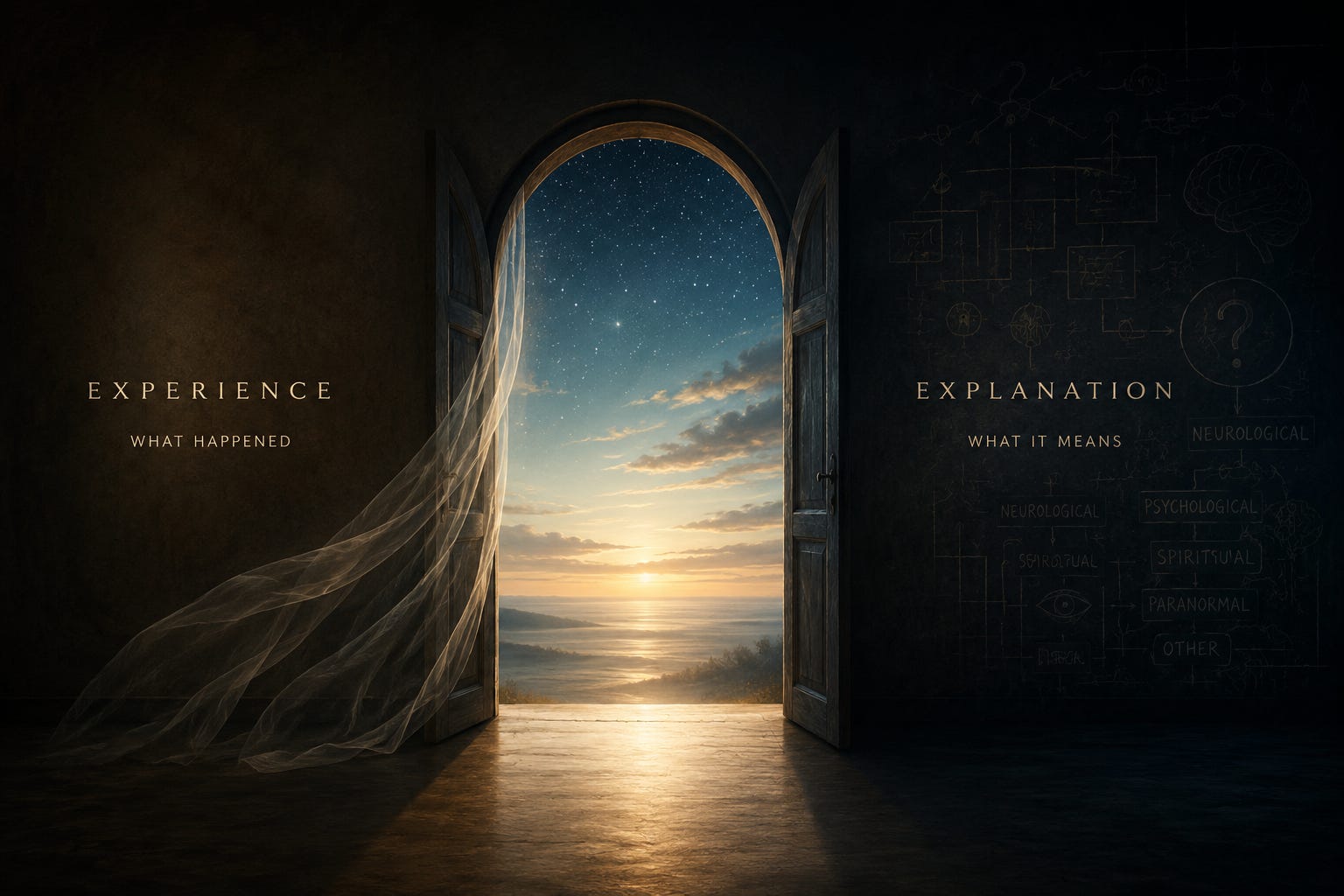
One of the things I have become increasingly aware of while listening to experiencers, conducting interviews, reading case reports, and reflecting on my own experiences is how quickly discussions about sleep paralysis move from experience to explanation.
Someone describes waking in the night, unable to move. They describe a presence in the room, a sense of interaction, a voice, a touch, a pressure on the chest, a vivid environment, or an encounter that feels profoundly real. Yet almost immediately, the conversation shifts away from the experience itself and toward a different question entirely.
What was it?
The answers vary depending on who is being asked. A clinician may describe the experience as a sleep-related hallucination. A psychologist may interpret it through the lens of symbolism, trauma, or the unconscious. A religious person may view it as a spiritual encounter. Others may understand it as contact with external intelligences, deceased loved ones, or non-ordinary aspects of reality. In many cases, the debate begins before the experience itself has been fully described.
Over time, I have come to think that this tendency may be one of the reasons discussions about sleep paralysis so often become polarised. People frequently disagree about explanations, yet they may be describing remarkably similar experiences.
The distinction between experience and explanation appears simple at first glance, yet I have become increasingly convinced that it is one of the most important distinctions in the entire conversation surrounding sleep paralysis and related experiences. The more time I have spent listening to experiencers, the more I have noticed that many disagreements arise not because people are reporting fundamentally different events, but because they are interpreting similar events through different frameworks.
This observation has shaped much of my thinking in recent years and, ultimately, played a significant role in the development of the Threshold Contact Experience framework.
The Rush to Explain
When I first began trying to understand my own experiences, I approached them in much the same way that many experiencers do. I wanted answers. I wanted to know what was happening and why it was happening. Like many others, I explored clinical explanations, psychological theories, spiritual interpretations, and paranormal literature. Each offered something useful. Each illuminated certain aspects of the experience while leaving other aspects unresolved.
What I did not fully appreciate at the time was how quickly I had moved from observation to interpretation.
The question occupying most of my attention was not, “What happened?” but rather, “What does it mean?”
Those questions are related, but they are not identical.
One asks us to observe. The other asks us to interpret. Both are important, but they do not occur at the same stage of inquiry.
Seeking explanations is a natural human response. Faced with something unusual, emotionally significant, or difficult to understand, most of us instinctively reach for a framework that helps us make sense of what happened. The difficulty arises when the explanation arrives so quickly that the experience itself is never fully examined, described, or understood on its own terms.
I have often wondered how many conversations about sleep paralysis begin with conclusions rather than observations. How many experiences are immediately classified, explained, interpreted, or dismissed before anyone has taken the time to ask what actually occurred? How many potentially important patterns disappear because attention moves too quickly toward explanation?
The tendency is understandable. Explanations provide certainty. They help us reduce ambiguity. They allow us to place unfamiliar experiences into familiar categories. Yet certainty can sometimes come at a cost.
The cost is that we may stop looking.
What Gets Lost
Imagine two individuals who describe remarkably similar experiences.
Both wake unable to move. Both report sensing another presence nearby. Both experience a strong feeling of interaction. Both describe the event as vivid, memorable, and profoundly real. Both retain unusually detailed memories after waking.
Yet one individual concludes that the experience was entirely neurological, while the other believes it involved an external intelligence.
The explanations are very different.
The experience, however, may be strikingly similar.
This observation stayed with me because it suggested that many debates surrounding sleep paralysis might not actually be debates about experience at all. They may instead be debates about interpretation.
When viewed from this perspective, the landscape begins to look rather different. Researchers, clinicians, spiritual practitioners, experiencers, and investigators may spend enormous amounts of time arguing about explanations while rarely pausing to consider whether they are describing the same underlying phenomenon.
A person reports a presence, and the experience is immediately classified as a hallucination. Another reports a similar presence and interprets it as a spirit. Someone else understands the same kind of encounter as a dream character, an archetype, a deceased relative, a non-human intelligence, or an expression of the unconscious. Each explanation may be meaningful within its own framework, yet none of them changes the fact that something occurred which the individual experienced as real, significant, and worthy of attention.
Over time, I found myself becoming less interested in deciding which explanation was correct and more interested in identifying what remained stable when explanations differed.
What features appeared repeatedly?
What patterns recurred across reports?
What aspects of the experience seemed to remain consistent regardless of interpretation?
These questions eventually became more compelling to me than debates about ontology. Not because ontology is unimportant, but because meaningful explanations require something to explain.
Description comes first.

Beginning with Experience
The more reports I encountered, the more difficult it became to ignore certain consistencies.
Individuals from different countries, belief systems, educational backgrounds, and worldviews often described experiences that appeared strikingly similar. The imagery might differ. The interpretation might differ. The meaning attached to the experience might differ. Yet certain structural elements appeared again and again.
Many reports involved the experience of presence. Others described interaction, communication, touch, movement, environmental changes, or shifts in perceived control. Some experiences left an unusually strong memory that persisted long after waking. Others appeared to influence subsequent dreams, perceptions, beliefs, or behaviours.
These recurring features became increasingly difficult to dismiss as isolated curiosities.
This observation gradually shifted the way I approached the subject.
Rather than beginning with the question, “What is this?”, I became increasingly interested in asking, “How does this experience unfold?”
That shift may seem subtle, yet it changes the entire direction of inquiry.
Instead of beginning with conclusions, we begin with observation.
Why This Matters
The distinction between experience and explanation matters because it creates space for careful observation.
When discussions begin with explanation, there is often an unspoken pressure to choose sides. Experiences become evidence for a particular worldview. The conversation quickly turns toward defending interpretations rather than exploring observations.
When discussions begin with experience, however, something different becomes possible.
People who disagree about explanations can still compare experiences.
Researchers, clinicians, spiritual practitioners, and experiencers can still examine recurring patterns.
Meaningful dialogue becomes possible because description provides common ground even when interpretation differs.
This does not require abandoning explanations. Nor does it require pretending that questions of meaning, ontology, or causation are unimportant. It simply requires recognising that explanation and experience are not the same thing.
An explanation is something we bring to an experience.
The experience itself comes first.
The Emergence of TCE
In many ways, this distinction sits at the heart of the Threshold Contact Experience framework.
TCE did not emerge from certainty about the ultimate nature of these experiences. It emerged from recognising that many reports appeared to share recurring structural features that deserved examination in their own right.
The framework does not require a person to adopt a particular spiritual belief, psychological theory, or metaphysical position. Instead, it begins by asking what occurred, how the experience unfolded, and what features were present.
Only after careful description does it move toward questions of interpretation.
This approach does not solve every debate surrounding sleep paralysis and related experiences. It does not tell us with certainty what these experiences are. What it does offer is a different starting point.
Rather than beginning with explanation, it begins with experience.
For me, that shift has become increasingly important. The longer I spend listening to experiencers and examining reports, the more convinced I become that meaningful understanding requires careful observation before interpretation.
Before we explain an experience, we must first understand what we are attempting to explain.
And perhaps, in a field where explanations have often arrived before understanding, that is precisely where the conversation needs to begin.
About TRANSCEND
TRANSCEND explores sleep paralysis, Threshold Contact Experiences (TCEs), dream contact, consciousness, and the transformative potential of liminal states. Through lived experience, research, and phenomenological inquiry, it seeks to develop a richer language for understanding experiences that have often been dismissed, misunderstood, or reduced to existing categories.
New here? Browse the Subscriber Library, explore the podcast, or subscribe to follow the ongoing development of the TCE framework.